Go from zero to job-ready PCT — no four-year degree required
Intro to Patient Care Technician walks you through every essential skill — from taking vitals and operating EKG equipment to communicating with nurses and protecting patient privacy — so you can walk into your first clinical shift with real confidence, not just a certificate.

"Our job isn't just to teach you the skills — it's to make sure you walk into that first shift knowing you belong there."
— LLH School of Phlebotomy & Healthcare Technicians
What you'll learn
What you'll be able to do
- Perform fundamental patient care tasks — vital signs, bed baths, and repositioning — safely and accurately
- Demonstrate proper hand hygiene, PPE use, and infection-control protocols to protect patients and yourself
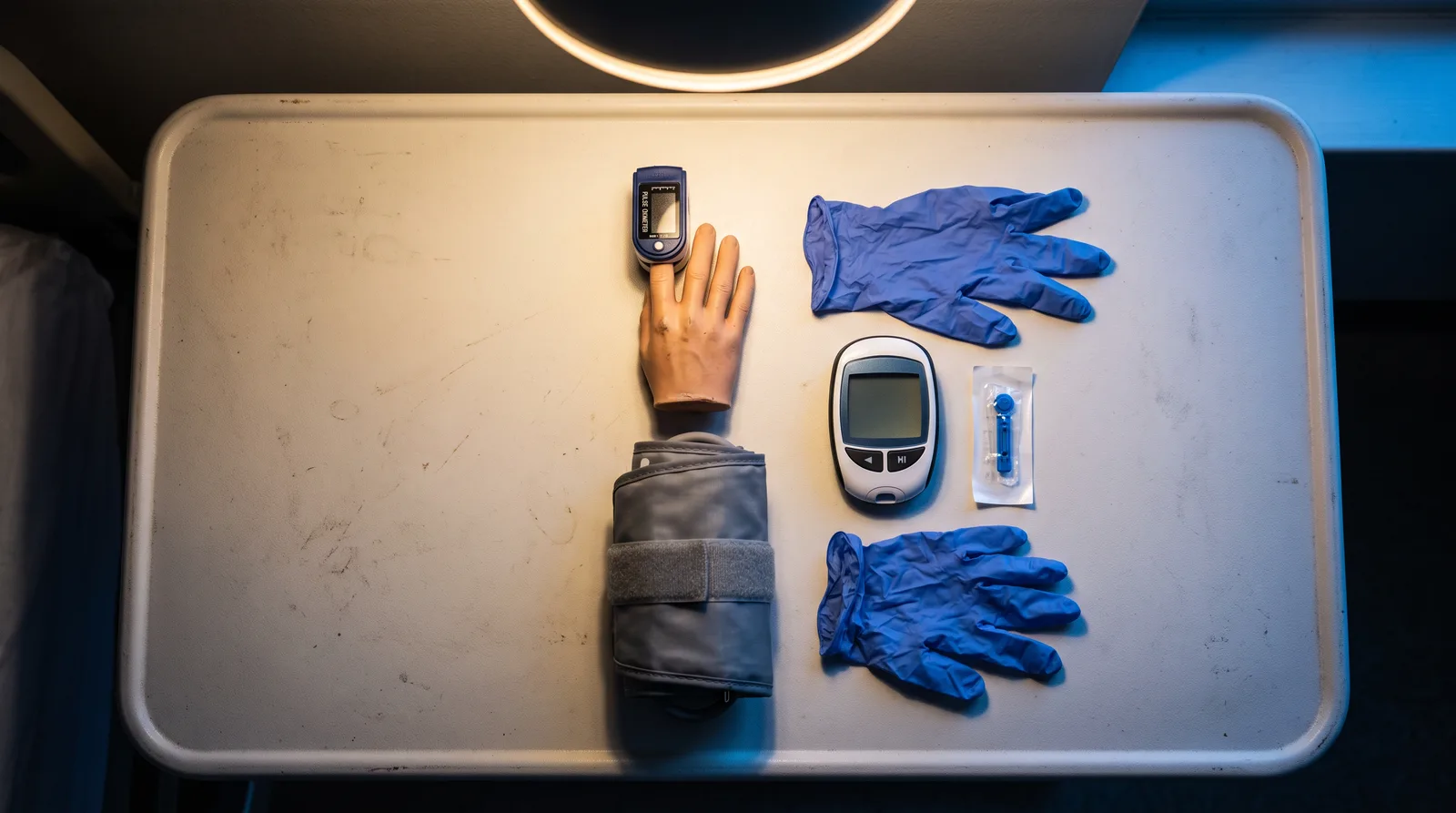
- Operate common clinical equipment including blood glucose monitors, pulse oximeters, and EKG leads
- Communicate effectively with patients, families, and nursing staff using professional healthcare language
- Recognize and respond to changes in a patient's condition, including when and how to escalate to a nurse
- Understand the legal, ethical, and HIPAA-compliance responsibilities of a Patient Care Technician role
How it works
A course that adapts to you
This isn't a set of static videos. Every lesson is generated live and tuned to where you actually are.
We learn your level
A quick placement check tailors your starting point so you're never bored or lost.
Lessons adapt as you go
Each lesson is written for your pace and your goal, adjusting as your skills grow.
Your AI coach keeps you moving
Checkpoints, feedback, and gentle nudges turn progress into a real result.
The curriculum
What's inside your course
8 modules · 64 lessons

Foundations of the PCT Role
Orients students to the healthcare environment, the PCT's scope of practice, and the legal, ethical, and HIPAA responsibilities that define the role.
- 1.1The PCT in the Healthcare TeamIncluded
- 1.2Scope of Practice and Professional BoundariesIncluded
- 1.3Legal and Ethical ResponsibilitiesIncluded
- 1.4HIPAA and Patient ConfidentialityIncluded
- 1.5Healthcare Settings and the Chain of CommandIncluded
- 1.6Professionalism, Appearance, and Workplace ConductIncluded
- 1.7Patient Rights, Consent, and Respectful CareIncluded
Infection Control and Safety
Builds the habits and protocols that protect patients, coworkers, and the PCT from healthcare-associated infections and workplace hazards.
- 2.1Hand Hygiene: The Foundation of Infection ControlIncluded
- 2.2Personal Protective Equipment (PPE)Included
- 2.3Standard and Transmission-Based PrecautionsIncluded
- 2.4Workplace Safety: Body Mechanics and Sharps HandlingIncluded
- 2.5The Chain of Infection and Breaking TransmissionIncluded
- 2.6Bloodborne Pathogens and Exposure ResponseIncluded
- 2.7Environmental Safety, Cleaning, and Medical WasteIncluded
- 2.8Patient Identification and Preventing Medical ErrorsIncluded
Fundamental Patient Care Skills
Develops hands-on competency in the daily physical care tasks PCTs perform most frequently at the bedside.
- 3.1Vital Signs: Measurement and Normal RangesIncluded
- 3.2Bed Baths and Personal Hygiene AssistanceIncluded
- 3.3Patient Positioning, Turning, and RepositioningIncluded
- 3.4Transfers, Ambulation, and Fall PreventionIncluded
- 3.5Intake, Output, and Specimen CollectionIncluded
- 3.6Making Occupied and Unoccupied BedsIncluded
- 3.7Nutrition, Feeding Assistance, and Aspiration PrecautionsIncluded
- 3.8Toileting, Elimination, and Incontinence CareIncluded
- 3.9Range-of-Motion Exercises and Mobility AssistanceIncluded
- 3.10Skin Integrity and Pressure Injury PreventionIncluded
Clinical Equipment Operation
Trains students to set up, operate, and troubleshoot the medical devices PCTs use routinely in clinical units.
- 4.1Blood Glucose MonitoringIncluded
- 4.2Pulse Oximetry and Oxygen Delivery DevicesIncluded
- 4.3Lead EKG: Lead Placement and AcquisitionIncluded
- 4.4Phlebotomy and Point-of-Care Testing BasicsIncluded
- 4.5EKG Basics: Understanding the Cardiac Cycle and Normal RhythmIncluded
- 4.6Phlebotomy Basics: Equipment, Venipuncture Sites, and Patient PreparationIncluded
- 4.7Blood Collection Tubes, Additives, and Order of DrawIncluded
- 4.8Specimen Labeling, Handling, Transport, and Common ErrorsIncluded
- 4.9Medical Equipment Safety and TroubleshootingIncluded
Communication and Patient-Centered Care
Develops the verbal, written, and interpersonal communication skills PCTs need to work effectively with patients, families, and the nursing team.
- 5.1Therapeutic Communication with Patients and FamiliesIncluded
- 5.2Professional Communication with the Nursing TeamIncluded
- 5.3Cultural Sensitivity and Inclusive Patient CareIncluded
- 5.4Documenting Patient Care AccuratelyIncluded
- 5.5Communicating with Patients with Hearing, Vision, or Speech LimitationsIncluded
- 5.6Caring for Patients with Dementia, Confusion, or Cognitive ImpairmentIncluded
- 5.7Managing Difficult Conversations and Patient BehaviorsIncluded
- 5.8Reporting, Recording, and the Importance of Objective DocumentationIncluded
Recognizing and Responding to Patient Changes
Prepares students to identify early warning signs of deterioration, escalate appropriately, and respond confidently in urgent clinical situations.
- 6.1Recognizing Changes in a Patient's ConditionIncluded
- 6.2When and How to Escalate to a NurseIncluded
- 6.3Emergency Basics: Responding Until Help ArrivesIncluded
- 6.4Normal vs. Abnormal Vital Signs and When to ReportIncluded
- 6.5Recognizing Respiratory Distress and Changes in OxygenationIncluded
- 6.6Recognizing Signs of Stroke, Cardiac Emergency, and ShockIncluded
- 6.7Falls, Seizures, Fainting, and Other Common Patient EmergenciesIncluded
- 6.8Rapid Response, Code Blue, and the PCT's Role During an EmergencyIncluded
Caring for Patients Across the Lifespan
Discover how to deliver compassionate, age-appropriate care to patients at every stage of life — from newborns and children to adults and the elderly. In this module, you'll explore the unique physical, emotional, and developmental needs that vary across the lifespan, and learn how to adapt your communication style and caregiving techniques accordingly. Whether you're assisting a pediatric patient or supporting an aging adult, you'll build the awareness and practical skills needed to provide respectful, patient-centered care to anyone who walks through the door.
- 7.1Understanding Age-Related ChangesIncluded
- 7.2Caring for the Older AdultIncluded
- 7.3Caring for Patients with Physical DisabilitiesIncluded
- 7.4Caring for Patients with Cognitive and Developmental DisabilitiesIncluded
- 7.5Behavioral and Mental Health ConsiderationsIncluded
- 7.6End-of-Life Care, Comfort Measures, and Supporting FamiliesIncluded
PCT Career Readiness & Certification Preparation
Get fully prepared to launch your career as a Patient Care Technician. In this final module, you'll review the core competencies covered throughout the course, sharpen your test-taking strategies, and build the confidence you need to pass your PCT certification exam. Beyond the exam, you'll learn how to craft a standout resume, navigate the job application process, and present yourself professionally in healthcare interviews. By the end, you'll walk away not just exam-ready — but truly career-ready.
- 8.1Understanding PCT Certification and Employer RequirementsIncluded
- 8.2Preparing for a PCT Certification ExaminationIncluded
- 8.3Building Your PCT RésuméIncluded
- 8.4Searching and Applying for PCT JobsIncluded
- 8.5Common PCT Interview Questions and Strong ResponsesIncluded
- 8.6Preparing for a Healthcare Skills InterviewIncluded
- 8.7Your First 30 Days as a Patient Care TechnicianIncluded
- 8.8Career Pathways: PCT to Medical Assistant, LPN, RN, and BeyondIncluded
Who it's for
Is this you?

Recent high school grads
Ready to start a real career right now — not four years from now — and wants a clear, direct path into a clinical role that pays and matters.

Career-changers seeking purpose
Leaving behind a job that never felt meaningful and finally ready to do work that genuinely helps people — without starting over with a bachelor's degree.

Stay-at-home parents re-entering work
Looking for a self-paced program that fits around family life and leads to stable, in-demand healthcare employment on a realistic timeline.

Future nursing students
Planning to pursue an RN or LPN program and wants hands-on clinical foundations — vital signs, EKG, infection control — before day one of nursing school.

Essential workers leveling up
Already working in a care-adjacent role — home health aide, medical receptionist, or CNA — and wants to expand into higher-skill PCT responsibilities.
Community college students
Supplementing an allied health program with practical, job-focused PCT training to stand out to employers before graduation.
Questions
Frequently asked
Online Learning
A note from LLH School of Phlebotomy & Healthcare Technicians
LLH School of Phlebotomy & Healthcare Technicians
If you're reading this, chances are you're ready to start a career in healthcare—but you may not be sure where to begin.
Maybe a four-year program isn't right for you right now. Maybe you've applied for healthcare jobs only to hear, “experience required.” Or maybe you're simply ready to learn new skills and start building a future you can be proud of.
That's why we created Intro to Patient Care Technician.
This course introduces you to the essential knowledge behind patient care, including vital signs, infection control, patient safety, bedside care, EKG, phlebotomy concepts, glucose monitoring, communication, documentation, and recognizing changes in a patient's condition.
But being a great PCT is about more than completing tasks. It's about knowing how to communicate with patients, protect their dignity, work with the nursing team, and recognize when something isn't right.
By the end of this course, our goal is for you to have a stronger understanding of the PCT role, greater confidence in healthcare fundamentals, and a foundation you can continue building on as you pursue your career.
You don't have to have your entire future figured out. You just have to be willing to take the first step.
Welcome to Intro to Patient Care Technician.
Your future in healthcare starts here.
— LLH School of Phlebotomy & Healthcare Technicians
Start your journey today
Get instant access — learn at your own pace with an AI coach in your corner.
$99/mo
Recurring billing · cancel anytime
Secure checkout · Instant access
- 8 modules, 64 lessons
- AI-adaptive lessons tuned to your level
- Quizzes & checkpoints to lock in progress
- Your own AI learning coach
- Learn on any device, at your pace
- Full access for as long as you're subscribed